Block height accuracy, equipped force, equal feeding, balanced compression, automation, soil, power and proof of strength: how to choose a CSEB block making machine.
Possible Machines Private Limited ·
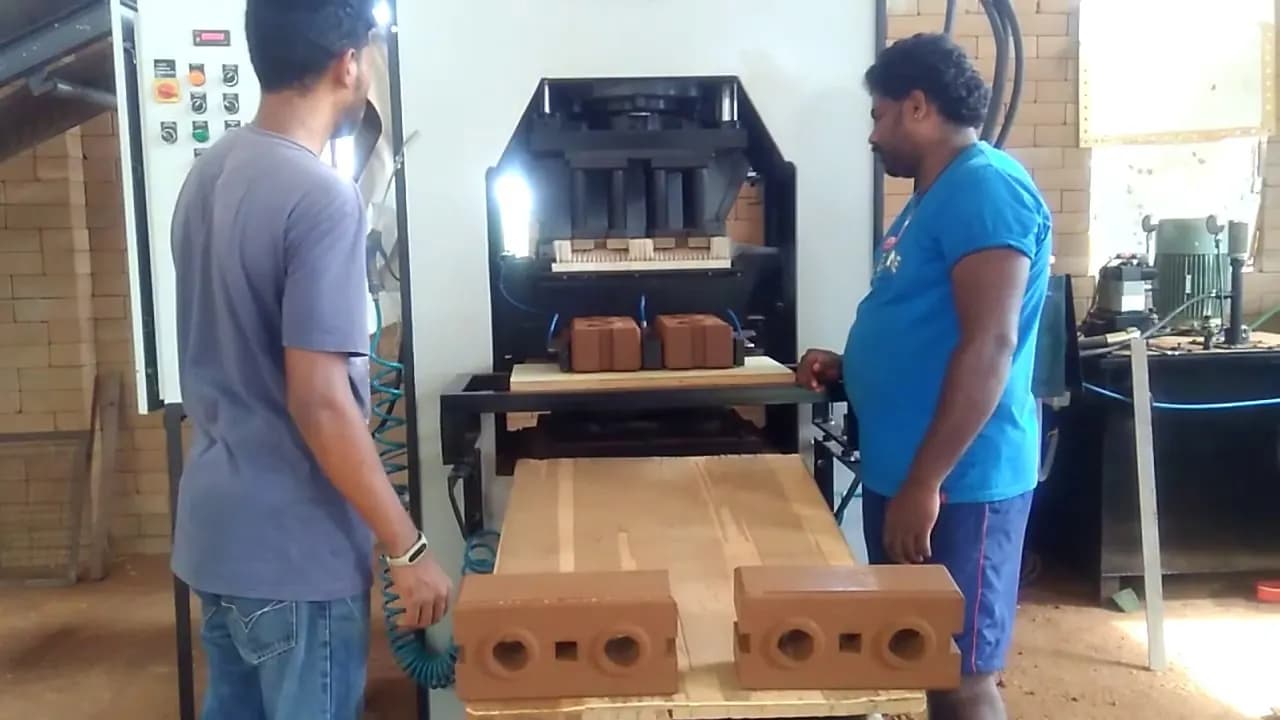
A 2 cavity hollow interlocking CSEB machine at Earth Blocks, Bengaluru. Frame from our YouTube video.
Compressed stabilised earth blocks are pressed from soil, a little cement and water, then water-cured. There is no kiln, no firing and no smoke, and a wall of well-made CSEB can be left exposed without paint or chemical treatment. That is why builders, architects and eco-resorts are turning to them. But the block is only as good as the machine that presses it. Here is how to choose one.
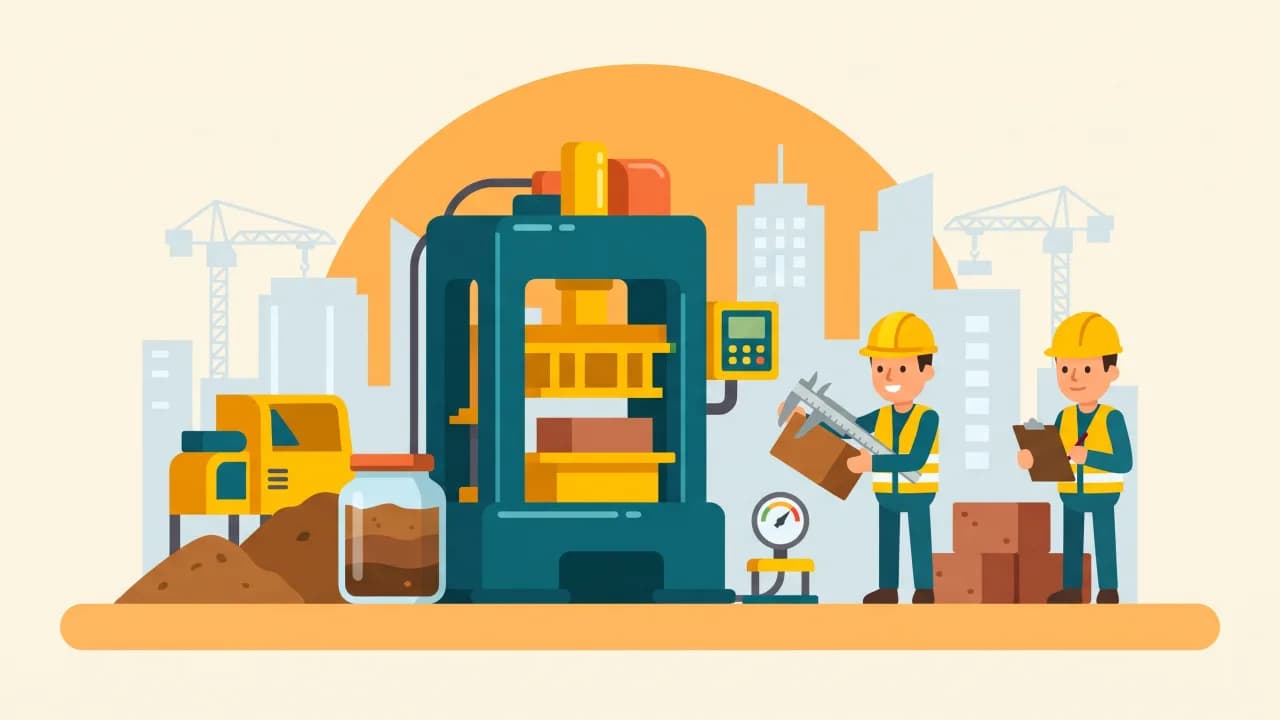
What to check when choosing a CSEB machine: block height, force, soil and output.
±0.8 mm
height accuracy on our interlocking machines
144.76
kg/cm² average strength, independent lab test
25–110 HP
power, from compact press to full plant
800 → 15,000
blocks a day, smallest to largest machine
1. Start from the blocks you can sell
Size the machine to your market, not the other way round. Count the builders, contractors and projects within delivery distance and estimate how many blocks a day you can sell in your first year. Then pick the machine whose output covers that on one shift, with room to add a second shift later.
Tell us what you want to make
Share the block type and daily output you need. We'll come back with the right machine and a price.
How accurate the blocks must be depends on how the wall is built. This is the first question to settle, and the one most often skipped.
Non-interlocking blocks
±2 mm
Laid block, mortar, block, like brickwork. The mortar joint takes up small differences, so a height accuracy of ±2 mm, as per IS standards, is fine.
Dry interlocking blocks
±0.8 mm
Stacked without mortar, locking into each other. Every block has to be within ±0.8 mm in height, or the wall leaks and blocks crack under load once the wall is up.
A block can only be as accurate as the press that makes it. To hold ±0.8 mm on the block, the machine's top and bottom plates must be parallel to within ±0.3 mm. Our interlocking machines hold ±0.8 mm. Over ten courses, that keeps a dry-stacked wall within about 8 mm even if every error added up; at ±2 mm the same wall could be 20 mm out.
Before you book an interlocking CSEB machine, ask the manufacturer in writing for the block height accuracy it holds, and how parallel its top and bottom plates are.
Accurate interlocking blocks stack and slide into place without packing. Video from our YouTube channel.
3. Check the force the machine is equipped with
Compaction is what turns damp soil into a dense, strong block. From what we see on our customers' plants, a block needs at least 22 tonf for every 72 sq in of block face, for blocks up to 90 mm thick, to get the best compressive strength and the best finish together. A 12 × 6 in block has a 72 sq in face, so that is 22 tonf per block, about 47 kg/cm² on the block.
Cavities (12 × 6 in blocks)
Minimum equipped force
1
22 tonf
2
44 tonf, so choose the nearest standard: 50 tonf
3
66 tonf
4
88 tonf
That is why our 2 cavity hollow interlocking line is built with a 50 tonf press, and our automatic plant presses with at least 25 tonf per block. If you face strong competition in your area, the same 2 cavity machine can be built with 60 to 70 tonf before manufacture, for denser, stronger blocks than your competitors'.
Don't judge by finish alone. Some manufacturers show a good finish made with very fine aggregate. Fine aggregate looks smooth but does not give the best compressive strength. Ask for the force and a lab strength report, not just a sample block. Bar, tonnes and kg/cm² are explained in hydraulic pressure for CSEB blocks.
4. Ask how every cavity is fed equally
A multi-cavity mould only makes equal blocks if every cavity gets the same amount of mix. If one cavity is under-filled, it is under-compressed: weaker, and short in height, which is exactly what ruins a dry interlocking wall. How the manufacturer plans to feed every cavity equally matters more than the brochure output, so ask for their feeding strategy before you go ahead.
5. Make sure compression is in equilibrium
Many buyers go for the most blocks per stroke. But more cavities make it harder to press every block with the same force. The applied force has to be in equilibrium, balanced across the mould, so that every block is compressed equally. A weak feeding mechanism breaks that balance too: an unevenly filled mould can't be pressed evenly.
Ask the manufacturer to show you that:
the total force divided by the number of cavities still gives at least 22 tonf per 72 sq in of block;
the press applies its force evenly across all the cavities;
the feeding mechanism fills every cavity with the same amount of mix;
blocks from the corner and the middle cavities come out the same height and strength.
Dual compression presses from the top, then the bottom, then the top again. It gives a honeycomb-free finish and makes blocks up to 150 mm thick, which is why our dual compression plant is the choice for exposed walls and large projects.
6. Choose the level of automation
A fully automatic machine batches, feeds, presses and ejects on its own, so the crew only loads raw material and stacks blocks. That means fewer people and blocks that do not depend on who is on shift. A simpler automatic press costs less and is easier to maintain, but needs more hands around it. We compare the two in automatic vs semi-automatic CSEB machines.
7. Plan for your soil
Lumps and stones in the mix cause weak spots and broken edges. A clean, sandy soil may only need screening; a clayey soil needs crushing and careful batching. Our automatic plant includes loader-fed soil processing, automated batching and an elevated pan mixer that filters out lumps. Test your soil before you buy: best soil for compressed stabilised earth blocks shows how.
8. Power, space and delivery
Power: 25 HP for the PMHB24, 40 HP for the 4 cavity machine, up to 79 or 110 HP for the automatic plant. All need a steady three-phase supply.
Space: a 50 tonf hollow interlocking line needs a shed of about 5,000 to 7,000 sq ft, plus open ground for curing and stacking.
Delivery: about 35 days for the 4 cavity machine, 30 to 60 days for the PMHB24, 45 to 60 days for the 50 tonf line, 60 to 90 days for the automatic plant and 3 to 6 months for the dual compression plant.
9. Ask for proof, not promises
Before you sign, ask the maker for three things: an independent lab report on blocks from their machine, videos of the machine running at a customer's site, and a visit to their works. Blocks made on our machine by Eagle Eco Industries, Jalgaon, averaged 144.76 kg/cm² in an independent IS 1725 test, nearly five times the 30 kg/cm² class 30 minimum. The full report is on our CSEB block test report page, and CSEB compressive strength and testing explains how to test your own blocks, including water absorption.
4 cavity CSEB plant, one of India's biggest CSE block plants. Video from our YouTube channel.
10. Compare the full price
Our listed prices run from about ₹32 lakh for the 50 tonf hydraulic hollow interlocking machine and ₹48 lakh for the 4 cavity automatic machine, to about ₹1.25 crore for the fully automatic plant with soil processing and batching. Prices are ex-works; GST, transport and civil work are extra. What changes the price is covered in CSEB block making machine price in India.
Before you buy a CSEB machine
Daily output sized to the blocks you can sell
Block height accuracy confirmed in writing: ±0.8 mm for dry interlocking, ±2 mm for mortar-laid blocks
Top and bottom plates parallel within ±0.3 mm for interlocking blocks
At least 22 tonf of equipped force per 72 sq in of block face, per cavity
Equal feeding of every cavity, and balanced compression across the mould
Automation level matched to your crew and power supply
Soil tested, and soil processing included if your soil needs it
Lab report, site videos and a works visit seen before you order
As a CSEB machine manufacturer in Nashik, we design, build, install and train on every machine, and support you once you are in production.
Planning a CSEB block plant?
Tell us your soil, the block you want to make and how many blocks a day you can sell. We will recommend the machine, send the layout and a quotation, and show you the machine working.