
Blog / CSEB and interlocking
Automatic vs semi-automatic CSEB block making machine
What a fully automatic CSEB machine does that a simpler press does not, and how automation changes crew size, block consistency, power and price.
Possible Machines Private Limited ·
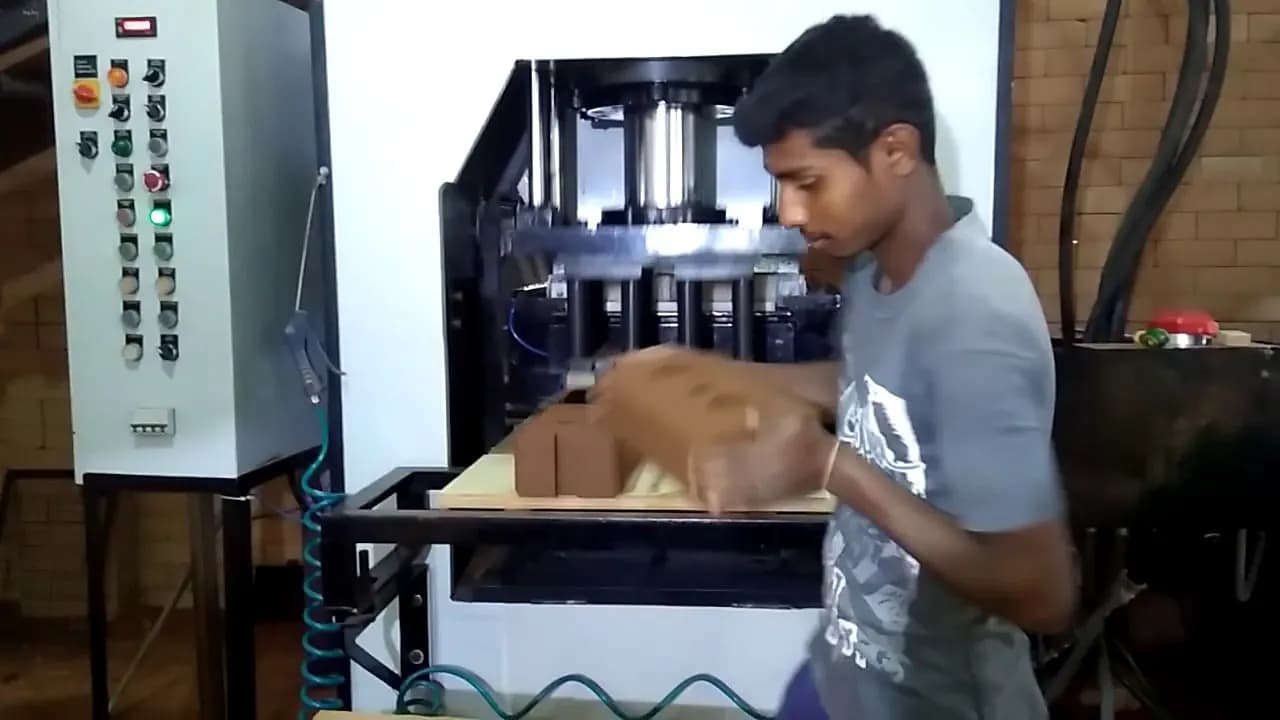
Every CSEB machine does the same job: press a damp mix of soil, stone crush and cement into a dense block. What changes from machine to machine is how much of the work around the press is done by people and how much by the machine. That decides your crew, your output and how consistent your blocks are.
What gets automated
| Stage | Simpler machine | Fully automatic plant |
|---|---|---|
| Soil processing | Screened by hand or a separate screen | Loader-fed crushing and screening |
| Batching | Measured by the crew, or a simple open batcher | Automated batching of soil, stone crush and cement |
| Mixing and feeding | Mixer loaded and emptied by the crew | Conveyor-fed pan mixer that filters out lumps |
| Pressing and ejection | Hydraulic, operator-paced | PLC-controlled hydraulic cycle |
| Block handling | Blocks lifted off by hand | Blocks out on a conveyor, no pallets |
Why automation matters for CSEB
- Consistency. Strength depends on the right cement ratio, the right moisture and the same compaction every time. When batching and the press cycle are machine-controlled, block 3,000 is made like block 1.
- Crew. Our automatic plant runs with a very small crew, with a loader, forklift and truck-mounted crane doing the heavy lifting. Simpler machines need more people to measure, mix, carry and stack.
- Output. Automation removes the waits between strokes. That is how the automatic CSEB plant reaches 3,000 to 4,000 blocks a shift.